
How is artificial intelligence reshaping the automotive industry and the engineering profession? Why is the development of autonomous vehicles progressing slower than anticipated? And most importantly, how should universities educate new generations of engineers at a time when artificial intelligence is taking over an increasing number of tasks?
Prof. Dr. Eric Sax, Director of the Institute for Information Processing Technology (Institut für Technik der Informationsverarbeitung – ITIV) and Dean of the Faculty of Electrical Engineering and Information Technology at the Karlsruhe Institute of Technology (KIT), speaks on these topics for the website of the Faculty of Mechanical Engineering, University of Belgrade. His professional journey bridges academic research with the development of electronic and software systems in the automotive industry, with a specific focus on systems engineering, embedded systems, and hardware-software integration. From this perspective, Prof. Sax discusses the key technological and organizational challenges of modern industry and the increasingly significant role of artificial intelligence in engineering. He particularly emphasizes that the future of engineering does not depend on the ability to compete with AI, but on the knowledge of how to utilize its capabilities in an efficient, critical, and responsible manner. This entails a strong scientific foundation, practical experience, and the ability to connect different engineering disciplines—competences that will become increasingly important in the development of highly integrated technologies.
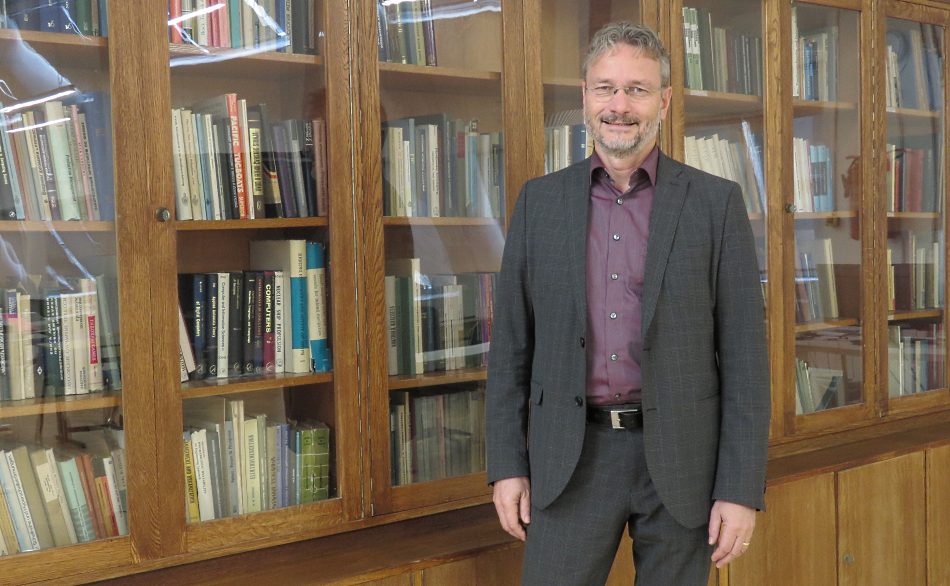
The occasion for this interview is the signing of the Agreement on Scientific and Technical Cooperation between the Faculty of Mechanical Engineering, University of Belgrade, and the ITIV Institute at KIT. The ambition of both institutions is for this initial step to evolve into a long-term partnership that will connect complementary expertise in mechanical engineering, electrical engineering, and information technology, encourage new scientific projects, and strengthen cooperation between academia and industry in Serbia and Germany.
What motivated you to initiate cooperation with the Faculty of Mechanical Engineering in Belgrade, and what potentials do you recognize in this partnership?
Today, it is highly important to possess an international perspective and to become acquainted with other regions, their educational systems, and scientific achievements. This is particularly significant for young people and doctoral candidates.
Generally speaking, I am very open to these forms of collaboration. Specifically, I believe that there is great potential in Eastern Europe, and in Serbia in particular. It is vital for us to familiarize ourselves with different educational and scientific traditions, understand the historical circumstances under which they evolved, and jointly consider opportunities for future development.
The immediate impetus for establishing this cooperation was our joint PhD student, Mr. Veljko Vučinić, whose research work connected Karlsruhe and Belgrade. This opened the door to further collaboration.
What opportunities does the signed agreement open up? When can we expect the first concrete activities, and how will students be involved in this cooperation?
I believe that the first step should be the launch of scientific exchange and the formation of working groups that would address the ideas we have discussed.
Researcher mobility and exchange represent a solid initial foundation. Furthermore, there is an excellent complementarity between our institutions: the Faculty of Mechanical Engineering is more oriented toward mechanical engineering, whereas our institute focuses more on electrical engineering and information technology. This forms an outstanding basis for pooling expertise and establishing joint research teams and projects.
A vital segment of our cooperation will be the co-mentorship of doctoral students, which will allow us to better understand one another, our scientific approaches, and our research work. However, cooperation should not be limited solely to doctoral studies. Student exchange, particularly at the Master’s level, could open up numerous new opportunities, especially if we conduct lectures in English at both institutions.
In this way, we can also become more attractive to industrial partners. Companies today rarely operate exclusively within a single country, whether in Serbia or Germany. They maintain an international perspective and require experts capable of collaborating across different parts of the world.
My goal is to build an international network that includes students, PhD candidates, professors, and industrial partners. Such a network would enable the exchange of knowledge and experience necessary for the development of joint scientific research.
Which areas hold the greatest potential for joint research between the Faculty of Mechanical Engineering and the ITIV Institute?
I see particular potential in embedded systems design and systems engineering, including the processes, methods, and tools that enable the integration of electronics, software, and mechanical components into a single, functional system. The objective is to unify these elements into embedded cyberphysical systems—ranging from robots and mobility systems to industrial plants.
During our visit to your laboratories, we had the opportunity to see highly interesting examples of automated industrial systems. It is precisely in such applications that it is necessary to connect artificial intelligence, electronics, microcontrollers, software, and mechanical components. This is a broader research area in which I see great potential for our cooperation.
These technologies are of great importance not only for the automotive industry but also for the Industry 4.0 concept and numerous other economic sectors. Nevertheless, I believe that the automotive industry and mobility systems could serve as the first concrete touch point for our research integration.
You are already collaborating with Professor Dragan Aleksendrić, not only through joint exchange of expertise but also through co-authoring scientific papers. How did this collaboration come about, and what research challenges are you currently working on, particularly in the fields of electric vehicles and active battery safety?
I would answer this question in the following way. In order to initiate cooperation and successfully develop joint scientific work, it is essential to build mutual trust, and personal meetings play a crucial role in this process. This is precisely why I came to Belgrade for the first time in my life, and I recognized a very open and warm spirit prevailing at the faculty.
I believe it is important to build our cooperation on such foundations, rather than reducing it strictly to meetings via Microsoft Teams or communication via email. Therefore, I highly value this opportunity to meet and exchange ideas.
I would like to invite you to visit us in Karlsruhe when Mr. Vučinić defends his doctoral dissertation in Germany. Karlsruhe might not be as beautiful as Belgrade, but we also have a few lovely places that I would like to show you. I would also like to introduce you to a larger part of our scientific work and the research we conduct. I look forward to that meeting and to the continuation of our cooperation.
How reliable are intelligent diagnostic systems in the automotive industry today, particularly when it comes to the reliability issues of autonomous vehicles, and what are the greatest challenges in real-time data processing, taking into account the various algorithms that can be used for anomaly detection?
About ten or fifteen years ago, we witnessed the first demonstrations of automated and autonomous driving. These were mostly examples that took place under favorable weather conditions, which led to high expectations from management within the automotive industry. However, we have not been able to fully meet those expectations because they were based on demonstrations that did not encompass the full variety of real-world driving conditions. Consequently, validation and quality represent some of the most critical aspects of automotive engineering today.
When we connect vehicles to external systems via wireless communication, enable data exchange, or apply artificial intelligence to vehicle control, we are essentially opening a Pandora’s box. This introduces new challenges in the fields of cybersecurity and real-time data processing. We cannot always fully predict what artificial intelligence and machine learning algorithms will calculate in specific situations. On the other hand, under real-world conditions, we can only test a limited number of possible scenarios and their variations. For this reason, it is difficult to anticipate in advance all the situations a vehicle might encounter.
Following a period of high expectations, the automotive industry entered a phase often referred to as the „trough of disillusionment“ (valley of tears)—a period in which it becomes clear just how much serious and thorough engineering work is required to transform promises into reliable products. Nevertheless, I am quite confident that we will succeed in overcoming these challenges, thanks to systematic validation, high-quality engineering analysis, and a realistic approach to the development of new technologies, rather than unrealistic promises.
We can observe that companies in China and California have, in certain respects, integrated software into vehicles more successfully than traditional European manufacturers. The reason for this lies, among other things, in different approaches to development.
The European automotive industry is historically rooted in mechanical engineering, meaning that software has mostly been retrofitted into existing vehicle concepts. In contrast, some companies in China and the United States started with the software and built the vehicle concept around it. This approach has demonstrated clear advantages in certain segments.
Therefore, it is essential for traditional manufacturers to find a way to better integrate software into existing engineering structures. A shift in organizational culture is also necessary, as automotive companies are increasingly becoming software-defined vehicle companies, while a large portion of the workforce still thinks primarily from a mechanical engineering perspective. It is precisely this shift and transformation that represent one of the greatest challenges we, along with our industrial partners, are facing.
How close are we to the widespread deployment of highly automated vehicles, specifically Level 3, 4, and 5 vehicles according to the SAE classification? Is their deployment a matter of the near future?
In China, forms of automated driving already exist in certain urban environments. However, in Europe, there is a vast number of regulations, so the situation cannot be viewed the same way across all parts of the world.
In Europe, individual rights and personal data protection are considered exceptionally vital values. This means that data cannot be used indiscriminately. For instance, when using cameras near pedestrian crossings, care must be taken not to violate people’s privacy and to ensure that their faces are not processed in a manner that allows identification, unless there is an appropriate legal basis for it.
In China, these issues are approached differently from both a regulatory and practical standpoint. Because of this, the conditions for technology development vary, creating a certain competitive imbalance. The question arises whether automated driving in divers urban conditions is truly an area where Europe should compete directly with China, or whether it should focus on other innovative technologies that depend less on privacy and personal data protection issues.
There are many other areas where we can regain a leading position, a „pole position“ so to speak. My goal is for us to focus on those areas and find specific niches for the application of automated driving. We discussed, for example, platooning, vehicle automation within depots, and the application of automated systems in restricted and controlled environments.
We should start with such applications instead of immediately trying to solve the most complicated problems of automated driving in urban environments. Therefore, I really do not want to compete with China in an area where I cannot even shift my car into first gear yet, while they are already in fifth. Simply put, it is difficult to keep up with them. It is a completely different approach.
The development of electric and autonomous vehicles, as well as the application of artificial intelligence, requires new competences from future engineers. In this regard, which skills and competences do you believe could be the most crucial for future students of mechanical and electrical engineering?
That is the fundamental question. We reflect on this deeply because our graduates enter the industry and, during their first two years, learn how companies operate, develop programming skills, and acquire specific knowledge that we could not provide to the same extent during their studies. This knowledge is often closely tied to the operations and technologies of specific companies.
In the near future, artificial intelligence will take over a large portion of such tasks. A significant amount of knowledge will be easily accessible because people will be able to utilize tools like ChatGPT or Claude. Therefore, we should no longer ask how our graduates can compete with artificial intelligence, but rather how they can use it within companies in an efficient, critical, and responsible manner.
If we visualize a company’s structure as a pyramid, its lowest base consists precisely of our university graduates. However, due to the implementation of artificial intelligence, that base is shrinking drastically, reducing to a very small fraction—causing the entire structure to look more like a Christmas tree, so to speak. Consequently, we must redirect education toward the second level.
But what does that second level look like? How will they utilize artificial intelligence? This implies that we must abandon an exclusively theoretical approach to teaching and pivot more toward practical work. We need to teach students how to apply artificial intelligence to streamline their own work, using their foundational scientific and engineering knowledge.
This represents a major shift compared to the traditional way of educating. We must develop these competences very rapidly; otherwise, students might use artificial intelligence tools without proper control and critical evaluation, which can lead to erroneous results.
Therefore, I believe that integrating artificial intelligence, including large language models, into teaching and developing the competences of our graduates is one of the most critical tasks in the near future. A Cooperation Built to Last
How do you envision the cooperation between the Faculty of Mechanical Engineering and the ITIV Institute over the next five to ten years?
I hope that this initial impetus, our visit, and Mr. Vučinić’s doctoral dissertation will serve as a foundation for launching new initiatives and encouraging others to join this cooperation. I believe that this first contact can open the doors to numerous similar activities in the future.
Candidly speaking, it is essential to establish our cooperation on broader foundations, involve more researchers and students, and create the conditions for its long-term development. This will not happen on its own. We must remain conscious of the importance of this process, maintain contact, and continuously work on advancing our collaboration.
The optimistic scenario involves expanding our current activities, building a robust partnership, launching joint projects, and involving industrial partners from both Germany and Serbia. The goal is to truly power up this „engine“ of cooperation, which has only just started running, and ensure its continued development.
However, this requires serious effort and commitment, a continuous exchange of knowledge and experience, as well as joint scientific papers and projects. I hope that in the near future, we will succeed in achieving exactly that level of cooperation.
(Source: Faculty of Mechanical Engineering University of Belgrade, Serbia)